Sunday, July 12, 2015

Lynn Canal and Chilkat Bald Eagle Preserve

One of the cruise stops was Skagway. We had an excursion to the Chilkat preserve nearby, so we boarded the fast ferry to Haines. By now we were used to seeing lots of eagles and other wildlife, and the ferry ride was no exception. The Lynn canal is a beautiful waterway with steep walls and waterfalls. There were eagles and harbor seals along the route.

Chilkat was a bust. We boarded a bus in Haines and rode along the river to a sightseeing business. There, we boarded a flat bottomed boat with jet motors to cruise the shallow river. We got a glimpse of a massive terrestrial glacier in the distance on a mountain, and we saw one eagle perched in a tree. And that was about it. The guide stopped at a few empty eagle nests. We saw almost no wildlife. Finally, we went back to the dock, really disappointed. As we ate lunch, the business owner put on a show. He spotted an eagle sitting in a nearby tree, so he pulled out some fish from the refrigerator, injected 3 of them with air using a syringe, and one at a time he tossed them into the river. Each time, the eagle took flight, plucked the fish (which floated because of the injected air) from the water, ate the fish in flight, then landed back on its original perch. Here's a selection of the shots I got, which were helped by the fact that I was pretty close to the action.
Slowing Down


Getting Ready to Grab

Plucking a Floating Fish

Checking the Catch

Coming Back for More


About to Snatch

About to Eat on the Fly


One More Time

Gliding Down for Food

Maneuvering

Slowing Down

Got Another Snack


Aside from the eagle feeding show, this excursion was a waste of time. Timing is everything; the Chilkat Preserve does have a lot of eagles, especially in the Fall, but we saw hardly any of them. I've seen more eagles in my neighborhood than I did in the Chilkat Preserve. I saw more eagles from the Haines ferry dock than I did in the preserve.

Saturday, July 11, 2015

Tracy Arm

This was my favorite day of the trip. It was gray and dreary as we started, with intermittent rain.
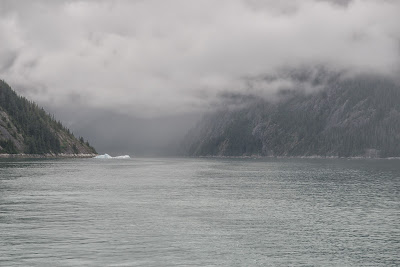
Tracy Arm

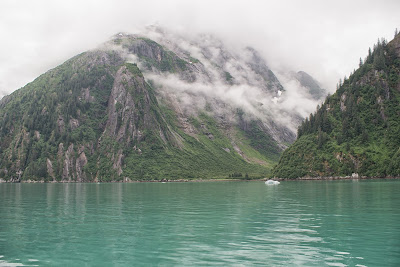
Green Water in Tracy Arm
On a fast boat we headed south from Juneau to Tracy Arm, right into fog at the entrance. The water color gradually changed from dull gray to deep green. The fog and overcast weather slowly improved until we arrived at South Sawyer Glacier, where it was sunny under partly cloudy skies. The water color near the glacier was dirty/milky.
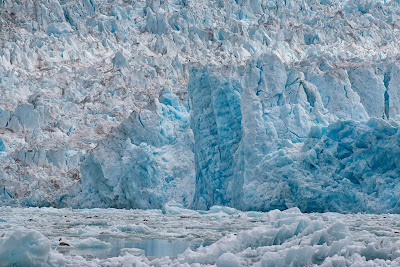
South Sawyer Glacier

The captain shut the engines down as we came to a stop a few hundred feet from the glacier face. We were surrounded by floating ice in a fjord with steep walls. I could clearly hear cracking sounds coming from the glacier, along with a steady stream of melting water and ice and rocks as it splashed into the fjord.
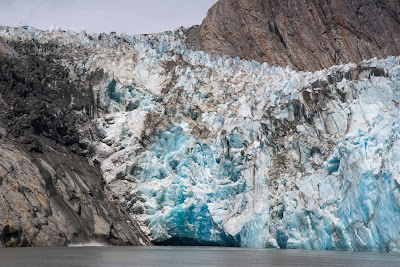
Meltwater Streams from Dirty Ice
The sun took the bite off the cold, but it was still chilly. I was expecting the blue ice and it was very cool to finally see it. In these shots I did not process it to bring the blue out; I merely set the white balance and added a little clarity, or boosted the whites when needed.
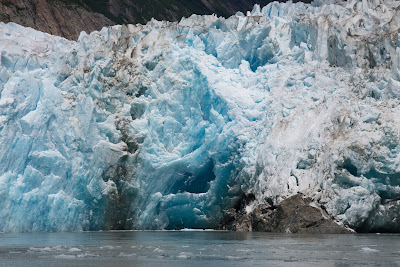
Dirt, Rock, and Blue Ice in South Sawyer Glacier
The glaciers that I've seen in Europe and Washington (Rainier, St. Helens) always seemed stark white, with almost no variation in color or detail. The Alaskan glaciers that I saw on this trip all had blue in the faces and streaks of dirt and rock.
After what seemed like only a few minutes, but was actually more like a half an hour, the captain started up the engines and we proceeded back the way we came toward North Sawyer Glacier.
North Sawyer Glacier
I found it difficult to judge the size of the glaciers. Here's a tour boat that's some distance away from the glacier face.
North Sawyer Glacier
At this glacier, there was a thin overcast. As we approached, we began to see ice floes with harbor seals hauled out onto the ice. Everywhere I looked, there were seal mothers with pups.
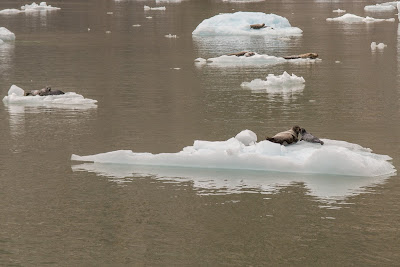
Harbor Seals
Again, the engines stopped and we lingered, surrounded by ice and seals.
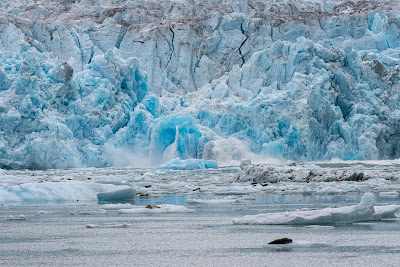
North Sawyer Glacier
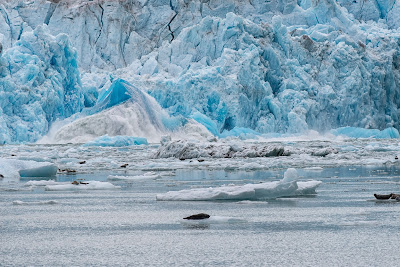
Again, there was the popping and cracking sounds of shifting glacier ice. After we were there for a while, a piece of ice dropped from the glacier face with a continuous rumbling sound. Just when I thought the event was over, a huge piece of blue ice emerged from the water with the sound of rushing water that was running off of the ice. It was a shooter - a block of ice that calved below the surface of the water. As that died down, yet another piece of ice fell, and there was a second shooter. These were enormous pieces of beautiful blue ice that took some time to settle down and stop shedding water, with continuous sounds of moving water and rumbling. Shortly afterward, a wave of water gently rocked our boat. I can't show the whole sequence, but I'll put a few shots in.
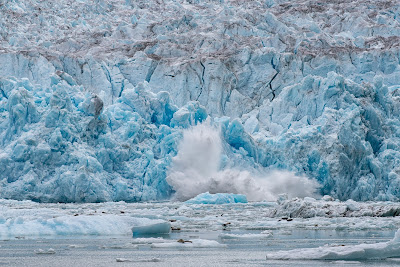
Calving Glacier
Block of Blue Ice Emerges from Water
Glacier Shooter
We lingered a while longer, then returned to Juneau. As we approached the Stephens Passage, the clouds lowered again and we spent the rest of the trip in overcast and rain. For more than an hour, as we cruised along Stephens Passage, I watch the forest and shore go by, with dozens of eagles perched in the trees. Dall porpoises jumped in our wake. Loons and other birds dove as we approached. And occasionally there was the spewing water of a whale blowing. We were really lucky with the weather (it was great when it counted). And the shooter was amazing. I don't know how this could have been a better day.

Wednesday, July 8, 2015

Ketchikan

The ship arrived on an overcast morning. I saw the shore sliding by out the window as I woke up and went out on the balcony. I immediately heard the distinctive sound of eagle chatter. A closer look at the shore with binoculars showed eagles. Lots of them. In trees near the shore. They were too far away to photograph, but cool. The ship eventually dropped anchor in the channel. We rode a tender to shore and were glad to walk around after a day and a half at sea. We wandered by the dump, where I barely had time to get the camera out to grab a few shots of this bear. The clouds had cleared by then.
Black Bear at the Ketchikan Dump
Later we walked along the stream in town, and along the waterfront. This eagle sat in this tree while people walked by below on the sidewalk.
Bald Eagle Watching Pedestrians in Ketchikan
Lots of airplane traffic buzzed by. There were seaplanes everywhere, constantly coming and going, presumably taking tourists on sightseeing flights.
de Havilland Beaver

de Havilland Beaver
While we were at sea, and again as we departed Ketchikan, whales were visible.
Well,relatively visible. The first sign is usually a cloud of water spray as the whale blows.
Humpback Whale Blows
Then a little of the back shows up, with the dorsal fin briefly visible.
Humpback Whale
 Then it disappears. If it's going on a deeper dive, the fluke will briefly appear.
Humpback Whale begins a Deep Dive
There were Dall porpoises everywhere. They look like miniature orcas. I tried but failed to get good photos. They're just too fast.
Dall Porpoise

Tuesday, July 7, 2015

Canadian Coast

During a recent cruise from Vancouver to Whittier, I went to sleep as we entered the Strait of Georgia. I woke up as we exited the strait into the Pacific. I had to grab my camera to shoot this golden sunrise. I don't usually try landscapes, and this was a quick sequence from a moving ship in steady wind so I spent the rest of the trip hoping to see something useful when I returned home.
Sunrise at Sea

Sunrise at Sea near Vancouver Island

Saturday, July 4, 2015

Airplanes and More Airplanes

We went to the Boeing Factory and Future of Flight Museum in Everett, Washington. The factory tour was very cool, with views of the 747, 777, and 787 lines. The speculation is that the 747 line is nearing shutdown; we may have seen some of the last ones. The 787s looked like shiny plastic tubes. And we saw a KC-46 parked outside, along with lots of 787s. The factory is huge, with incredibly long tunnels below the assembly floor. No pictures allowed. The museum was kind of lame, but I liked the observation deck. We saw a Dreamlifter parked near the museum.
Dreamlifter
 The only photos I could take during this visit were at the museum. Here's a shot of the factory from the museum.
Boeing Everett Factory
 Highway 526 runs right through the Boeing Facility. When airplanes come out of the factory above, they are towed across the road (over a bridge) to southern part of the campus, near Paine Field. There they are painted in one of the buildings shown below. On the morning of our visit, there was an unpainted 777, a KC-46 tanker, a pair of 787s, and I think that's a 767 on the right.
Paint Sheds and Airplanes at the Boeing Factory
 Looking farther to the right, the parking lot was full of 787s, with a few 777s and 747s visible.
Airplanes at the Factory
Later in the day we went to the Museum of Flight near Seattle at Boeing Field. It too was cool, and I especially liked the walk through of the Concorde, a 787, and a retired Air Force One. The 707-based Air Force One looked really archaic, surprisingly so. Kennedy, Johnson, and Nixon all used this particular airframe before a pair of newer aircraft replaced it. The president's stateroom and conference table were cramped and uncomfortable-looking. I imagined Nixon using that plane and I think he wasn't much better off than modern 1st class. I had always heard that the Concorde cabin was cramped. It was. I took no pictures at this museum because everything was so packed together and full of people.

Friday, July 3, 2015

Mount St. Helens

Twelve years ago, I visited Mount St. Helens with my daughter. It was my first look at a volcano, and I came away awed by the extent of the destruction that is still evident so many years after the 1980 eruption. That trip in 2003 was on a bus tour. I recently had the opportunity to go again, this time driving a car and with a better camera. We approached it on a beautiful Summer day, with diminishing clouds it suddenly came into view.
Mt. St. Helens
 We kept driving to the end of the road at Johnston Ridge, and the mountain got bigger as the landscape got more desolate.
Mt. St. Helens from Johnston Ridge
 The lava dome in the crater is clearly visible. It causes the glacier to part and flow around it.
Lava Dome and Glacier
We walked along some of the paths near the visitor center. Very little grows in the blast zone because the soil was stripped away. Here's a spot that was (relatively) sheltered from the blast, so trees grow there while all around it, hardly anything can grow. Stumps and logs remain from the blast.
Blast Zone
 If you look closely, there's a path in this photo, with people on that path. This ridge was stripped by the blast.
Blast Zone
 There are stumps everywhere. Even in this very rainy climate, the trees haven't reestablished the forest.

Stumps in the Blast Zone
 And here are a few more shots from the barren landscape.
Blast Zone

Pumice Plain


Wildflowers

Blast Zone

Blast Zone