Showing posts with label Maine. Show all posts

Thursday, August 13, 2020

Bigelow Preserve Hike

My son and I hiked through the Bigelow Preserve in Maine. I've wanted to try this hike for years and we finally did it. 

Here's a view looking north at Flagstaff Lake with scattered cloud shadows:

Panorama Looking North from the Summit of Bigelow Mountain

Let me set the stage.

My in-laws have a vacation home in Maine. The Appalachian Trail passes nearby. Over the years, I've passed the Stratton trailhead dozens of times while driving highway 27 through the Carrabassett Valley. The north side of the valley is dominated by the Bigelow Preserve. The south side is dominated by Sugarloaf Mountain.

I prepared for this hike as follows:

  1. Last year, my son and I hiked part of this trail by parking in Stratton and climbing on the trail to Cranberry Pond. This was about 4 miles in, then back out by the same trail. We had seen 4 miles of the trail.
  2. I reviewed the topographic map of the trail. I knew that there would be several significant climbs.
  3. I read trail reviews online. The trail length was reported as just over 16 miles.
  4. My normal walking pace is about 3 mph. I planned for 2 mph on this trail for a duration of 8 hours.
  5. My son and I scouted the trailhead at Long Falls Dam Road. This was to be our entry point.
  6. My wife, son, and I went looking for moose near Stratton. On the way, I showed my wife where the Stratton trailhead was located so she could pick my son and me up at the end of the hike.
  7. I packed a backpack with food and drinks that I expected to be enough for the trip.
  8. There was a storm with torrential rain. I waited 2 days for the trail to dry out.
I don't hike often, but I've done a significant amount. I've hiked up/down mountains in the Alps. I've hiked up/down mountains in Shenandoah National Park. I hiked through Haleakala caldera with my son. Just 8 months ago, I hiked the Nā Pali Coast and the Sleeping Giant trails on Kauai. I ride my bike. A lot. My son is in Army ROTC. He works out. A lot. We're both active, in good health, and have hiking experience.

Here's what went wrong:

  1. Before leaving on vacation, I looked all over the place for my Sawyer water filter. I couldn't find it. I hit the trail without it. And of course this means that, even though I packed a lot to drink, we ran out. Well, not really, but almost.
  2. After my wife dropped us off at the Long Falls Dam Road trailhead, we encountered a sign that said the distance to the Stratton/Highway 27 trailhead was 17.8 miles, not the 16 I had expected.
  3. Much of the trail was very rocky, not at all like the 4 miles that we had already seen. Our progress slowed.
  4. I had a cell phone signal for about the first half of the hike, then nothing. I texted my wife that our pace had slowed and told her to wait an additional 2 hours before picking us up.
Here's what went right:

  1. The views are stunning. Looking north, all of Flagstaff Lake is visible. Looking south, we were treated to a great view of Sugarloaf Mountain and the airport in the valley.
  2. We had plenty of food.
  3. The weather was wonderful.
  4. The trail was mostly dry.
  5. My new Garmin watch was very helpful in keeping situational awareness: how far we had gone/climbed, pace. After the hike, it was very interesting to see the stats and track.
We made the first climb. It was strenuous. We were rewarded by great views. We descended, then ascended to the highest peak. Once again, we had stunning views. I told my wife that we would take 10 hours from the start, not the 8 that I had projected. Then the trail got much harder, just as I lost the cell phone signal. We slowed way down because of the trail conditions, and we were about half way to our destination, and we had gone through more than half of our water.

We came upon a hiker who was filtering water at a spot on the trail. It was clear to me that we would run out of water, so I asked him for a favor: I explained the situation and asked if he would filter some water for me and my son. He agreed and gave me more water than I was hoping for. His trail name is Mud Crack. Thank you Mud Crack! My son and I actually reached the end of the trail with a few ounces of water left, thanks to you.

OK, long story short: my son and I pressed on, made the two remaining climbs and descents, and got really tired. There were two more events of note. The sun went down behind the peaks and suddenly we were in shadow. I began to worry about running out of daylight. We were much slower than expected and we were on the shaded side of the valley. I had not expected to still be on the trail and had not brought a light. The trail got better and we picked up the pace as best we could. When we finally reached the trailhead, we were four hours later than originally projected, and two hours later than our rescheduled arrival. My wife had gotten worried and went to check a nearby trailhead to see if maybe we had gotten lost. My son and I arrived at a deserted trailhead, with no cell phone signal, and could only wait. She showed up after about 10 minutes.

OK, lessons learned:

  1. I'm not hiking again, at least not for a day trip this long, without a water filter.
  2. I'm not hiking again, at least not for a day trip this long, without a flashlight or headlamp.
  3. If I hike this section again, I will get to the trail head at sunrise (we got there about 60 minutes after sunrise and I'll plan on 12 hours, not 8).


Wednesday, August 12, 2020

Maine Moose

I'm fortunate to be able to take vacation in Maine almost every year. When it's uncomfortably hot and humid in Northern Virginia, it's great weather in Maine.

When we (my family) and I are in Maine, we always look for moose. They're unlike any animal that I see in Virginia. There's a highway between Stratton and Rangeley. Moose frequently graze along the side of the road as the sun is setting. This year we saw three moose during our trip on this road.

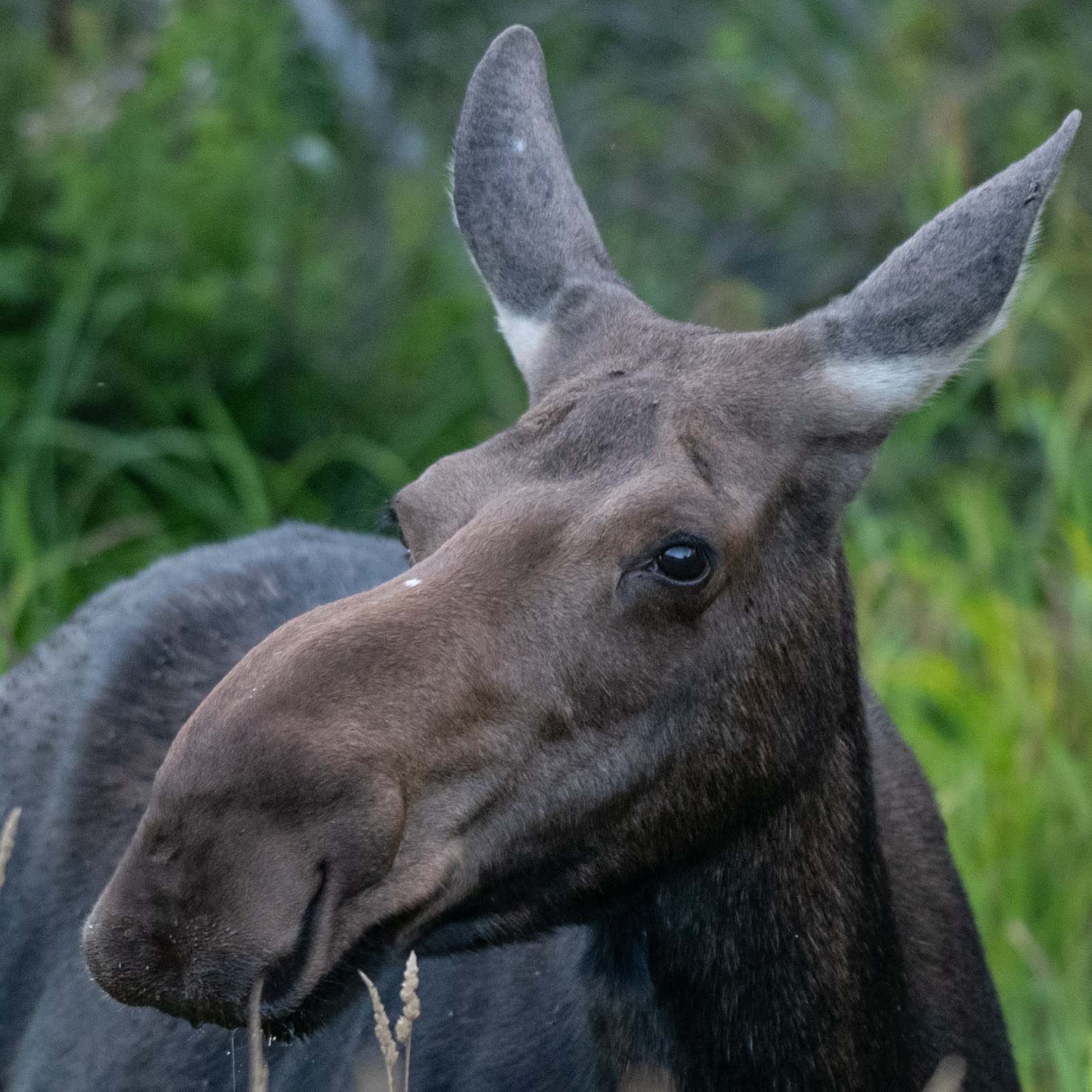
The first moose disappeared into the woods almost immediately after we saw her. The second moose was down in a ditch, partially obscured, hard to get good shots of. Here's the best of the sequence.

Cow Moose Looking at Me
Cow Moose
We drove away, leaving this moose behind. Farther down the road, we saw a bull that was standing in a shallow stream. By the time we saw him, we were already past, so I found a safe spot to turn around and went back. By this time the moose had moved closer to the road. We had several minutes to observe this animal as he came closer to the car. I even had the impression that he was going to come close to the car to check us out. As he crossed the road (we were stopped on the opposite side of the road), another car approached and spooked him. He ran into the woods.
Bull Moose Crossing the Road
Bull Moose
On another day, my son and I also had a rare middle of the day sighting while we were scouting the trailhead for a hike we were planning. We rounded a bend in the road and saw a bull on the road. I stopped the car and he went into the woods. As we passed the spot where he disappeared, we saw another moose in the woods with him.

On yet another day, as we were driving back to the vacation home, we had a brief glimpse of another moose next to the road.

So, the total for this trip is six. Most years we see no moose at all.


Wednesday, August 14, 2019

Maine

It's August, it's Maine time. I visited my in-laws' summer home on a pond in Maine. This "pond" is what I would call a lake; it's that big. The loons were not as plentiful as in previous years, with a maximum of only four at any one time. I was spoiled last time, with as many as 12 adults and a juvenile on the lake. Between laziness (I slept in a lot), rain, and overcast, my loon photography opportunities were poor. There wasn't even a juvenile this time. However, it wasn't a complete shutout.
Common Loon
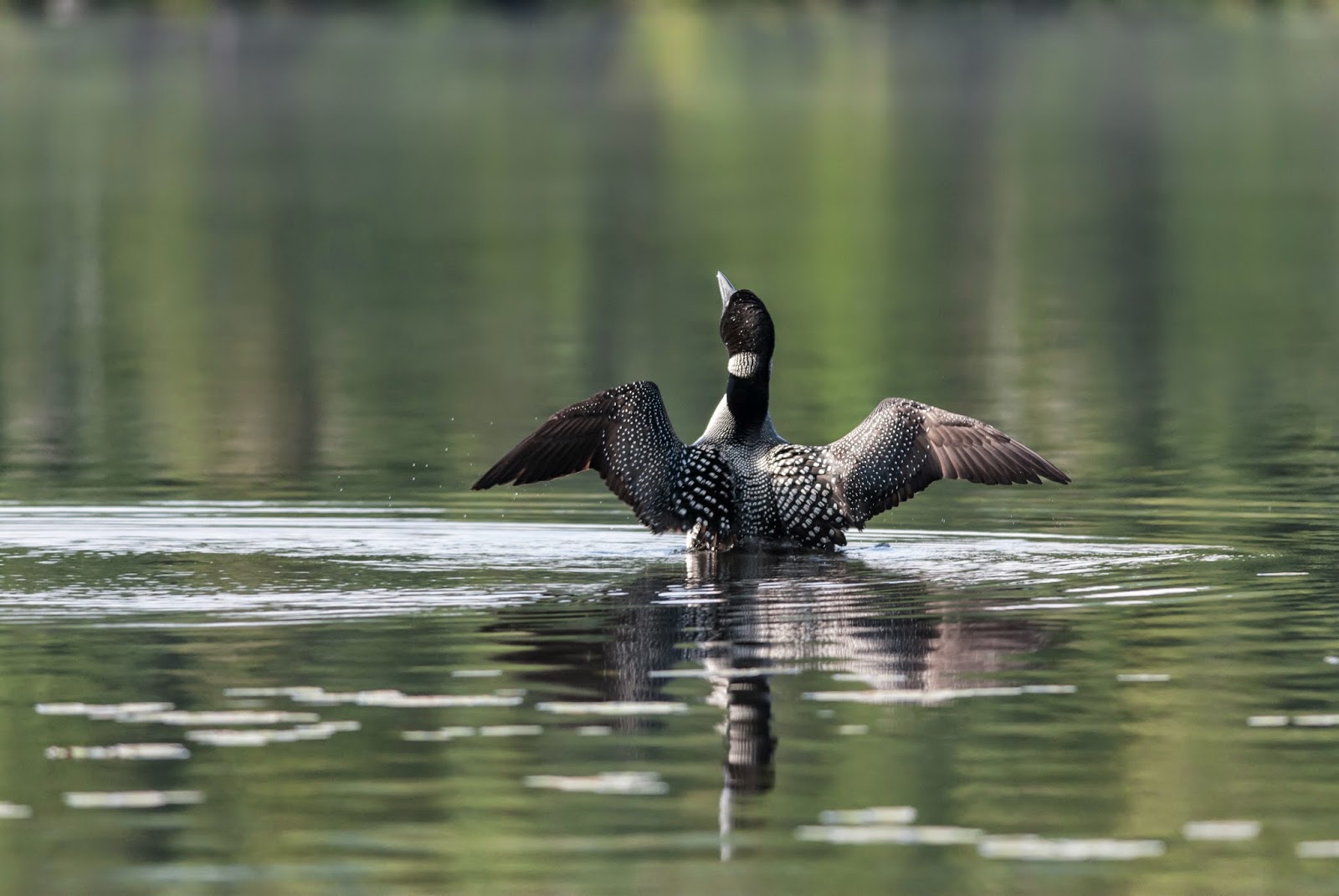
It's always a challenge to: find them, paddle over to them without spooking them, get to the sunlit side of them, and be ready with the camera when they do something worth shooting. I always try to get the red eyes lit by the sun. When the sun is wrong, the eyes appear black. The loon above popped up from a dive right next to my kayak, showing the big beak and lines of water beads. At random times, a loon will spread its wings, stick its neck straight up, and shake it out, sending water drops flying. This is a really challenging exposure to get right, with the white belly and black head. I have to be careful to underexpose the whole shot so I avoid blowing the white belly out into a mass of white with no detail. This kind of shot also needs a little motion blur, so it's a fine line between a shutter speed that's fast enough for the lens and shaky kayak, but not so fast that there's no blur in the fast moving head.
Common Loon
The road between Stratton and Rangeley is popular with moose. Actually it's popular with people who look for moose. They (the moose) come out of the woods and wander through bogs and ditches looking for food. The time to go is dusk, which means it's a challenge to get good exposures. But I was able to get some keepers of this cow. Her calf was nearby but trotted into the woods before I could get the camera out. Mom stayed in sight for a while. I opened the sun roof and stood up in the (stopped) car to get several shots of this moose in the gloom. It was a challenge to get these shots with my 300mm lens. Opened all the way to f4, I didn't dare shoot slower than 1/320. I had to stay busy on the focus button as the moose moved around because f4 gives pretty shallow depth of field. Some of my shots have the nose or ears in focus, but not the eyes. Nevertheless, I continue to be really happy with the high ISO results I'm getting with this camera.
Cow Moose
I've always had trouble getting shots of kingfishers. They're pretty shy. I'd say that they are as shy as they are chatty. And they make a lot of noise. This one was busy claiming its territory as another kingfisher kept flying by, so this bird stayed unusually still, lucky for me. I happened to be close by in a kayak as this interaction took place and I was able to paddle quite close and grab my camera for this shot.
Kingfisher
 There were lots of cedar waxwings on an island in the lake. I was able to paddle close to this one. While kayaks are great for shooting swimming birds, sadly they're not so great for shooting birds above.
Cedar Waxwing
We went out moose hunting twice. And on the second trip, I was lucky enough to get some shots of this bull, also near Stratton. The evening was pretty dark. I had to punch the ISO way up and open to f4 and 1/320. Even then I had to punch this up in postprocessing to get a usable final product.

Bull Moose
This was my first time shooting moose since I got a good camera. The challenges are: finding them, getting good exposures in the gloom (dark animal, dim lighting), keeping good focus on the eyes while they wander among bushes and tall grass (autofocus kept choosing the lighter colored grass in the foreground). I've seen them plenty of times in Maine, just not in the last few years. It was nice to finally find a few of them and get some usable shots of these large, lumbering animals.
Friday, August 12, 2016

Maine Loons

I recently made my annual trip to Maine for vacation. I've had a whole year to look at my last batch of loon photos, and I went with the goal of capturing more action. I mean, how many shots of loons serenely swimming can I stand?
Obligatory Serene Profile Shot
If there was action, especially water flying, I wanted to shoot it. I got lucky a few times with loons popping up near my kayak. The close proximity and bright morning sunlight let me get some shots suitable for close crops. This one included water streaming from the beak, a deep red eye, lines of beaded water on the head, and texture in that furry head.
Dripping After a Dive
In the summer, adults have their breeding plumage, but underneath those feathers, they are brown. You can only see the brown (down?) when they lift their wings.
Showing the Colors
They float along socializing or fishing. Fishing means sticking the head in the water, and if they spot prey, they dive. The head-in-water thrust is often vigorous.
Looking for Prey
After surfacing, they sometimes spread their wings and shake the water out. This reveals the white underfeathers and white bellies.
Wing Spreading
I saw this display a few times. The loon was among several other loons, suddenly got very loud, stood up, and started splashing.
Puffing that Chest Out
Here's another close crop from a loon that popped up from a dive near the kayak.
Checking Me Out After Surfacing from a Dive
There was one juvenile. Its parents were frequently absent from this youngster, off fishing I guess. I encountered it several times, with and without parents present.
Mom and Junior
I have no idea how that juvenile could eat this fish that is larger than the bird's neck. But eat the fish it did.
Breakfast!
And here's my favorite of the trip.
Shake it Out!
I'll finish with some poor photos, but I'm including them because I like the action in them and I was unable to get anything better...

These birds were made to swim. Flight is not their strength. Here's a shot of a loon that I saw passing overhead, it circled, and landed. The huge webbed feet are hanging out there.
Loon in Flight
Loon takeoffs are excruciatingly long as they swim and flap to gain speed and then they eventually lift off, but have to keep paddling and flapping until they clear the water.
"I THINK I CAN FLY"
Landing is even more comical. They glide over the water, feet dangling behind, neck outstretched, until they touch down and ski/skip over the water until they slow down.
Touching Down
Overall, I had a lot of fun. I went out every morning before 7AM, sometimes catching them in their morning gathering. On my last morning there, I found a group of five, which then merged with a group of four. They never grouped together in a way that allowed me to get a shot of all nine, so I have nothing to show for it. They annoyingly neglected to do any real interactions, no splashing or other displays. Adding the juvenile, I saw ten loons that morning, and that's my single-day record.

Friday, August 21, 2015

Loons

The Common Loon is my annual target when I take vacation in Maine, where I stay in a house near a pond. They call it a pond, but it's a lake where I grew up.

I went out most mornings as the sun was just starting to shine strongly. Usually there was mist over the water. I used a kayak to paddle around the pond to find them. Last year, I was able to observe as many as five adults clustered together, and there were two juveniles, one of which was quite small. I was hoping for similar numbers this year. I wasn't disappointed.

Almost immediately, I found five together.
Five Loons Gathering
I quickly discovered how hard it is to get all of them in focus. I had trouble sometimes even with just two of them together.
Loons
I should have paid more attention to the aperture. I was so concerned about sharpness (shooting with a telephoto lens from a kayak) that I used 1/1000. Next time I'll boost the ISO. Nevertheless, I used what I learned last year to get between the sun and the birds and I tried my best not to spook or chase them, with a lot of success. Sometimes they popped up from a dive near my kayak and lingered nearby.
Loon with Dripping Beak
Sometimes I was able to get shots showing the beads of water on their heads.
Loon
Their webbed feet are pretty large.
Loon Shows its Webbed Foot
There was a lot of looking into the water for fish.
Loons Looking for Fish
There was frequent "standing up" to shake their feathers out.
Shake it Out
Sometimes they splashed around a lot.
Splish Splash
I had remarked to my mother-in-law that I had never seen any loons flying in 20+ years of going to Maine. That's probably because I just never paid attention. I saw it happen several times this trip, but was only able to capture one event.
Loon Taking Flight
I was disappointed to see no juveniles for several days and I feared there weren't any this year. Boy was I wrong.
Juvenile Loon with Feathers Replacing Fur
Even Junior shakes the wings out every now and then.
I have Wings Too!
I had never seen loons stray into the shallows with the grasses and lilly pads before, until this trip.
Not Sure What's for Breakfast
And the largest group I saw had eight adults.
Eight Loons Together
So, including the juvenile, there were at least nine individuals there during this trip, up from at least seven last year. I'm pleased with the results this year, but I'll have to work at better depth of field next time I see a group. Because we usually visit late in the breeding season, we usually don't get to observe juveniles riding on a parent, and this year was typical: the juvenile was too big for riding.

Saturday, August 30, 2014

Loons

I recently made my annual trip to Maine. The place I stay is on a pond, which I would call a lake, but they call it a pond there. Each year, I look for the resident loons, either from the shore or while I'm out in the kayak.

Photographing from a kayak has some interesting problems. The boat never tracks straight. If there's any chop at all, it's really hard to hold the camera steady, especially with a long lens. If the birds move to the right or left of me, I can only turn my torso so far to track them before the boat lists uncomfortably and I fear falling in with my expensive camera. When I set the paddle down to use the camera, I fear I'll lose the paddle (although this year I used a paddle leash). And I fear getting my camera wet from paddle splash. I use a Black Rapid strap and I'm confident I won't drop the camera, but I have to take care to put it in just the right spot in my lap so it's out of the way of the paddle. So, there are some challenges.

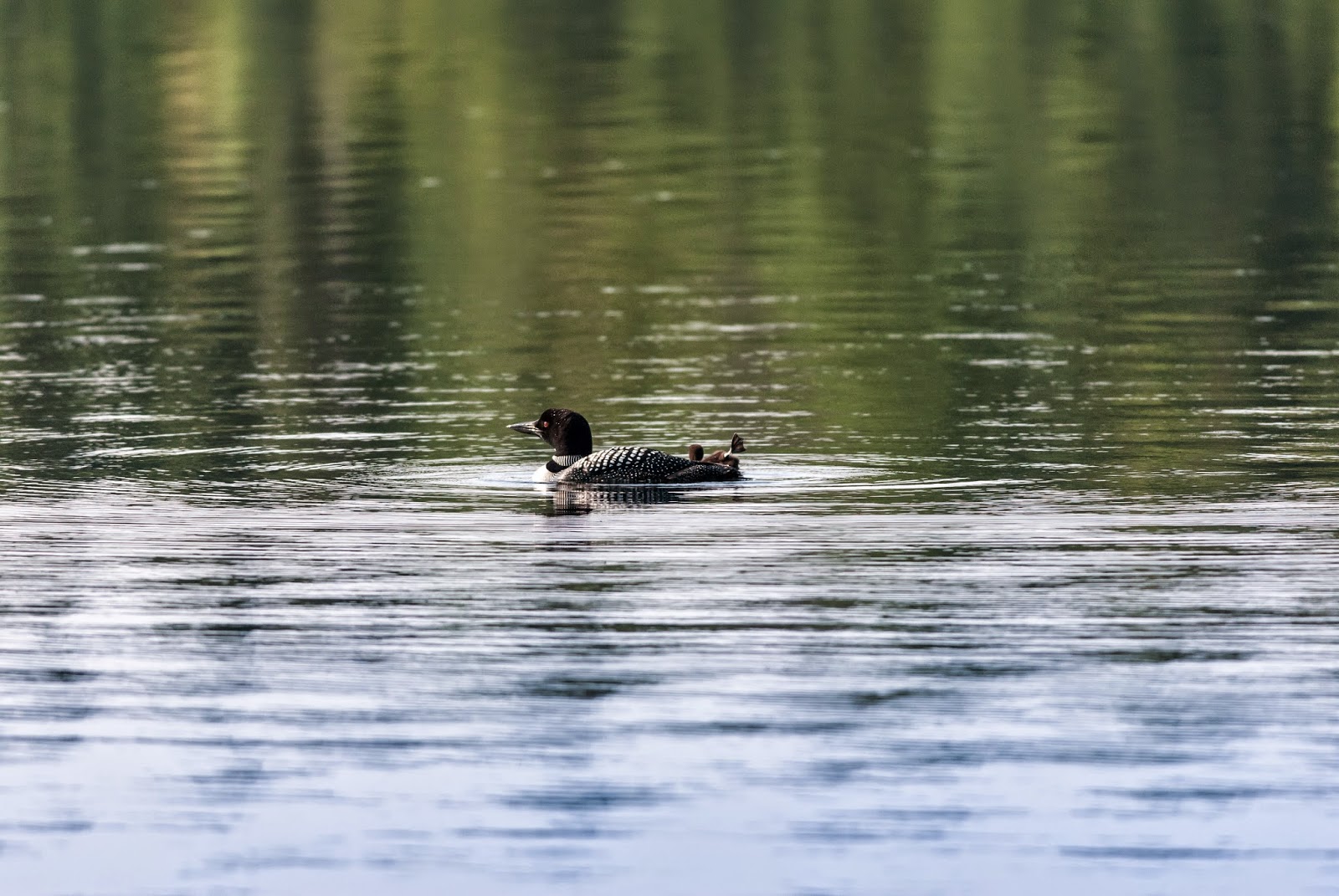
This year it seems there were two breeding pairs, each with a single juvenile. One morning I saw five adults in the middle of the lake. I was able to observe some behaviors that I hadn't seen before, probably because in previous years the juveniles were already quite large by the time I arrived in August. Here's a shot of a juvenile riding on its parent's back. I've seen plenty of pictures of this behavior, but this was the first time I've seen it myself. Occasionally the parent would "stand up" in the water to stretch its wings, causing the juvenile to tumble into the water.
Juvenile Riding on Parent
I also noticed that when the parent "stood up" to stretch its wings or rolled over to shake a webbed foot in the air, the juvenile would mimic its parent.
Loon Stretches its Wings
Juvenile Shows its Foot
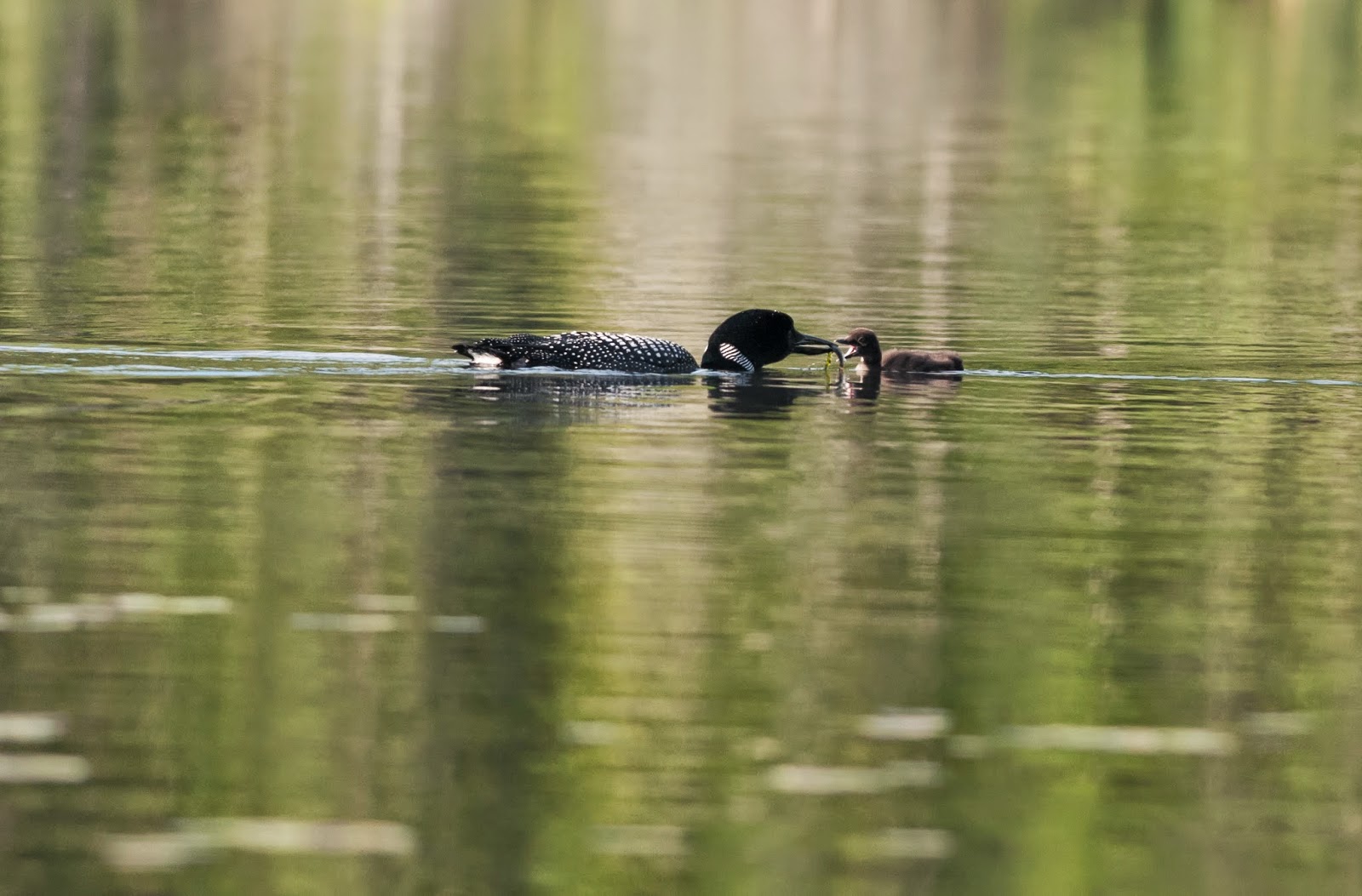
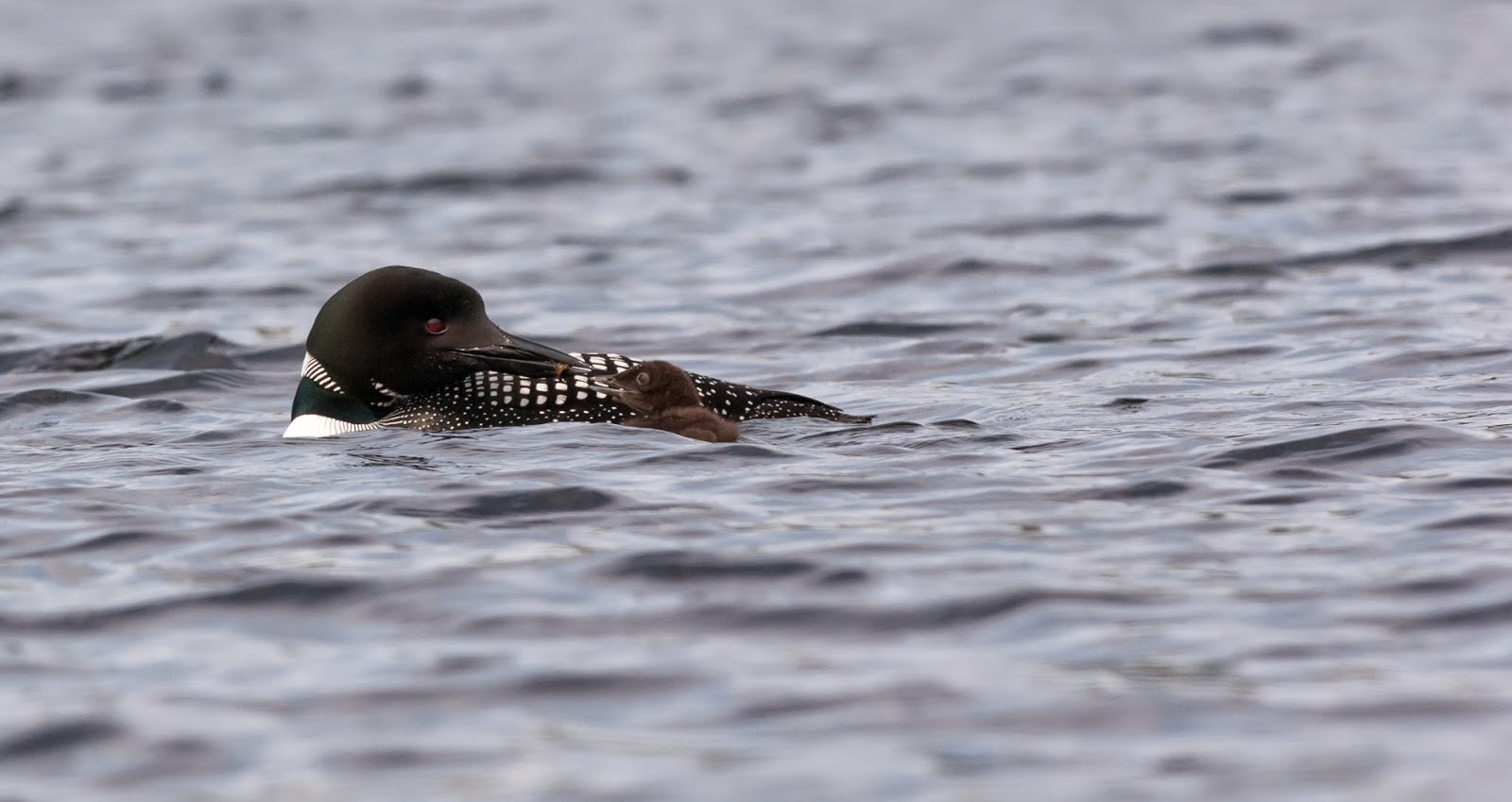
One of the two juveniles this year was incredibly small, leading me to believe it hatched late. At various times I observed its parents diving (which is nothing special), then surfacing with a small fish (they usually eat while submerged), which they took to their offspring.

Junior Opens Wide
Well, not "they". Both parents would dive. But only one would feed junior. When the other parent surfaced with a small fish (usually with some plant material stuck in its mouth too), it would give the fish to the parent who primarily stayed with the juvenile. Then that parent would feed junior. During one morning when a family chose to hunt close to the place I was staying, I was able to put a chair on the dock and just sit and watch, occasionally getting some photos. I observed the juvenile diving sometimes. Once when both parents were under, junior dove too. Both parents surfaced, found junior missing, and then one let out the typical loon wail, calling junior. After a few more seconds junior popped up and eagerly went to get more to eat from its parent.

Here's a photo of the larger juvenile.
Juvenile with Parent
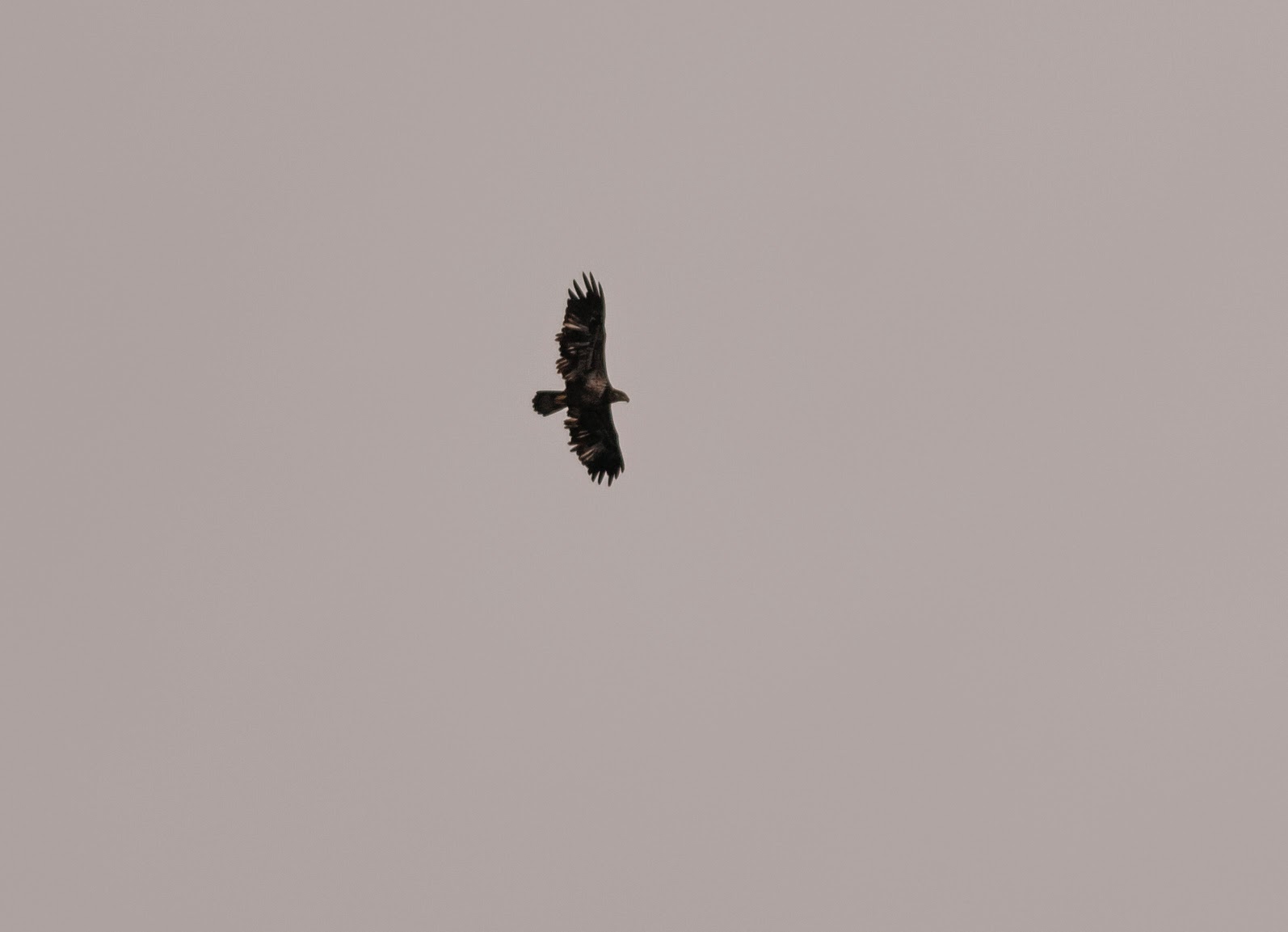
I was conflicted when I saw this bird circling above the pond; bad news for small defenseless birds! Good that eagles are thriving though.
Juvenile Bald Eagle at Hancock Pond
Finally, here's my favorite shot from this trip.

Feeding Time