Showing posts with label Hawaii. Show all posts

Friday, December 25, 2020

Hawaii Vacation During the COVID-19 Pandemic

My wife and I plan our vacations with long lead times. Sometimes we have plans for a vacation more than a year from now. This helps us get good travel deals and allows us to give our employers plenty of notice. We planned a trip to Hawaii before we had ever heard of COVID-19. We had also planned a July vacation in Iceland. And I had planned to cycle across Iowa in RAGBRAI 2020. We cancelled both of those trips. Or, more accurately, they were cancelled for us. Back to Hawaii... 

As the date of our trip approached, we considered cancelling. The COVID infection rates seemed to decrease over the summer, only to worsen as winter approached. Should we stay? Should we go? 

 The state of Hawaii imposed strict testing/quarantine requirements as the government allowed businesses to reopen. It was possible to make the trip, but should we? I study things that interest me. A lot. I don't want to get sick. I don't want my family to get sick. Whether staying home or travelling, I wanted to know what to do to improve my chances of staying healthy. How does one get sick with COVID? How can we protect ourselves? 

Bottom line: To get sick, one has to stay in close proximity to an infected person who is talking, singing, coughing, or breathing heavily (perhaps while exercising) for some number of minutes. Keep your distance, and you're safe. Can't keep your distance? Like passing someone in a store aisle or on a sidewalk or in a hallway? Make it very brief, and you're safe. How about masks? As far as I can tell, and this is based on a lot of reading and talking with health professionals, a mask won't protect you. Why wear one? A mask wearer's mask will trap a large fraction of the droplets that are expelled when coughing, talking etc. In short, a mask protects everyone EXCEPT the wearer. And while wearing a mask, you are less likely to touch your own face. If an infected person contaminates a surface, and you touch that surface, you are less likely to then touch your own face when you have a mask, so there is a small benefit to yourself when you wear a mask. 

In light of that analysis, what is the best course of action? We have to continue our lives and work. We have to go to the store, job site, doctor's office. We have to exercise and maintain the house. Life does not stop during a pandemic. The pandemic imposes a requirement to be careful, to be smart about what we do, but it does not mean we have to shut ourselves up inside. At least COVID-19 does not impose a requirement to cower at home. In my judgment, the most dangerous part of a trip to Hawaii is the time in the airport and on the airplane. We took our COVID tests, got our (negative) results, and flew to Hawaii. We wore masks in the airport and on the planes. We social-distanced as much as possible in transit. We got off the plane, showed our negative COVID test results, then promptly got tested again. Then to rent a car, we had to show our negative COVID tests. Then when we checked in to the hotel, we had to show our negative COVID tests. 

As I write this, I'm on the balcony watching the surf crashing. There are surfers playing in the waves. I saw a pod of dolphins swim by earlier. What's it like on the island during the pandemic? Lots of stores are closed. Traffic is lighter than I've seen in my four trips to this town. Everyone wears a mask in the stores. The tourist sites are still popular, but not crowded. We've travelled a lot around the island; we are NOT required to quarantine. We wear masks and keep our distance. And we're having a peaceful vacation. 

The last time we came, the Kilauea volcano had just gone through an increased phase of eruption that destroyed 700+ homes. But by the time we arrived, there was no eruption any more. That pause lasted two years. Hours after we arrived on this trip, a new eruption started. We were able to visit the Kilauea summit to see the beginning phase of the eruption as the summit caldera has a new lava lake forming. Along with several hundred other people, we went to the edge of the caldera as night fell and watched the cloud of gases rising as the glowing lava illuminated the crater walls and the cloud.
Kilauea/Halema'uma'u Eruption

The Kaloko-Honokōhau National Historical Park is near Kona. I went there several times last trip because it's a good spot for turtles and sunsets. On my first trip there this week, I was pleasantly surprised to see a lot of turtles AND an extremely rare monk seal. In fact, the monk seal was playing in the surf with a green sea turtle.
Monk Seal and Green Sea Turtle

I had so much fun watching the seal, I went back the next day. Unfortunately the seal wasn't there. But the sunset was wonderful and a surfer passed right in front of the sun at sunset.
Surfer at Sunset
Stay safe; stay healthy; Aloha!

Sunday, January 5, 2020

Kauai

I recently made a vacation trip to Kauai. I had visited this island once, more than 10 years ago and I was pleased to be able to make a return visit. As usual, I brought my camera. For this trip, I made a conscious effort to explore as much of the island as I could. This was no fun for the first part of my stay because it rained. A lot.

I made the drive along the rim of the Waimea Canyon to the Nā Pali Coast lookout. I made this trip long ago under better weather conditions. Here are a few shots. I wasn't able to get there at golden hour, so the shots are bland, but it's a cool place, so here they are.


This canyon, and the views of the Pacific beyond the upper end of the canyon, are world famous and my dash through it in an afternoon don't do it justice.

On another day, I visited Polihale State Park. Wow that was hard. First I had to drive well beyond Waimea to a part of the island that is nearly uninhabited. There's a naval base and a bunch of farms. At the end of the asphalt, I turned onto a dirt road that has the highest density of holes per mile that I've ever seen. It was five miles of bouncing through holes because it's impossible to avoid them all because they are too numerous. There's no stretch of that road that lacks holes. I think the last time a grader visited that road was when the road was built. Even in an SUV it was an ordeal that took an hour to get in and another hour to get out. And it was worth it. This was easily the best beach on the island and because it's so remote and hard to get to, there were very few people. Here's the view toward the Nā Pali Coast. The Air Force radomes are just visible on the cliffs.
Cliffs at Polihale State Park
 This beach also provides a good view of Lehua and Ni'ihau.
Lehua

Ni'ihau

Of course Hawaii always provides bird sighting opportunities. There were nenes everywhere. I mean nearly every golf course and fresh water lake or river has them. They seem nearly as numerous as the chickens.
Kauai Elepaio

One of the many Nenes at the hotel

Black Crowned Night Heron

Gallinule

One of the ubiquitous Cattle Egrets

White Rumped Shama

Red Footed Booby

White Tailed Tropicbird

Laysan Albatross
OK, not a bird, but there was a helicopter crash during my stay and this aircraft flew by, presumably on a search mission, while I was photographing birds at Kilauea Light.
SH-60 Seahawk

Great Frigatebird
Years ago, I hiked the Nā Pali Coast/Kalalau trail with my daughter as far as Honakapi'ai Stream. My son and I hiked it this time, going to the Honakapi'ai waterfall. We had better weather this trip.
Nā Pali Coast in February 2005

Nā Pali Coast in December 2019

As far as I'm concerned, any trip to Hawaii is a good trip. Even if there's rain. Even if the chickens are especially loud. Even if the trail is filthy muddy.

Friday, December 28, 2018

Papakolea Beach

My son and I made the trek to Papakolea Beach today. This beach has sparkling green sand because the surrounding rock contains olivine. It was an hour-long drive from our place in Kailua-Kona down to South Point, followed by a walk along the coast. The walk was three miles over uneven terrain, and it was hot, extremely windy, and dusty/dry because it's a desert, right along the Pacific Ocean coast. And because it's a desert, there was only dry grass, no trees, no shade. My son and I sunburn easily; we repeatedly applied sunscreen and he still came away with sunburned arms. I fared better.
This is a small beach
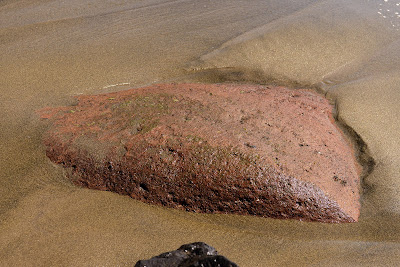
Red Boulder in Green Sand


Green/Brown Sand

This shot shows the whole beach


From a distance, the sand looks brown. Up close, it's absolutely a sparkling green. There were lots of people on the trail, and a few trucks driven by locals who charged tourists for the ride to/from the beach. So, long walk, uncomfortable conditions, cool, unique beach, and it was worth the trip.

Thursday, December 27, 2018

Nene

Last year on Maui my son and I hiked through the Haleakala crater. It was miles of arid, desolate landscape, walking on loose cinders. Eventually the footing became more solid in the part of the crater that gets much more rain. We reached a grassy area with a park service hut, which campers can rent. As we rested, a pair of Hawaiian geese, or nenes, to use the Hawaiian word for the birds, walked up to us. A third joined shortly thereafter, only to be shooed off by the first two. I left my heavy DSLR behind for this long hike and only had my phone to photograph them. Ever since that encounter, I've wanted to photograph them properly.

Well, on this trip to the big island, I've had my chance. While visiting Punalu'u beach, I saw several nenes along the side of the road by a golf course. I stopped the car, got my camera, and spent several minutes with them.
Nene
 When I first saw them years ago (during yet another Hawaiian trip), I thought they looked like the Canada Goose. I think I've read that the two species are related, with the theory that the nene is a divergent species after vagrants landed in and stayed in the islands. Their feet are only partially-webbed because they no longer need to swim. And those bands on their necks are unique.
Distinctive Neck Pattern
In fact, I made a point of trying to capture some neck detail in some of the photos. The bill also seems shorter than that of the Canadian goose.
Banded Legs
As with just about every endemic animal on Hawaii, the population crashed with the arrival of Europeans, and these animals are protected by law. The active conservation program includes capture and banding, which has obviously happened to this bird. In fact, every nene I've seen had banded legs, except for the one shown in the first photo above.

The nenes that I saw on Maui, and these on the big island, seemed to have no fear of humans, so it was easy to get quite close to them (but not too close, because that would be harassment, which is illegal). The birds on Maui approached to within a few feet of my son and me as we sat on a bench. These on the road by the golf course were also curious, looking at me and even approaching me as i photographed them.

Green Sea Turtles

I'm on a trip to Hawaii's Big Island. I've been here before, but was disappointed by my bad luck finding the famous Green Sea Turtles. I'm having much better luck this time. Punalu'u Beach, famous for its black sand, is a spot for frequent turtle basking. We stopped for a side trip while driving past. When we arrived, there were dozens of people on the nearby beach, standing near a pair of turtles.
Basking on Punalu'u Beach
There's not a lot of action when they're basking. I spent a few minutes photographing and watching and moved along, happy to have finally seen them.

Later during this trip I visited a beach near Kailua-Kona. There were four turtles swimming in tidal pools. Their shells were easy to spot in the shallow water. Occasionally one of them would raise a head to breathe. But it wasn't possible to get good photographs because all I'd see was a bit of the shell. I wish I had brought a polarizing filter. Farther along on the sandy beach, I found a pair of turtles on the sand.
Basking on the beach at Kaloko-Honokohau National Historic Park
One of the turtles had the number 14 painted on its shell; there was no number on the other one. Again, not much action, other than the man in a ridiculously colorful and tight Speedo who came hustling up to us as my son and I approached the turtles. I think he was about to berate us for turtle harassment until he realized that we were keeping a respectful distance from the turtles. He stood there silently, pretending to watch the turtles when in fact he was watching us, and finally after a few minutes he went back the way he had come, having never said a word to us. Maybe we disappointed him by giving him no reason to scold us.
Green Sea Turtle
My son and I sat on the sand about 20 feet away from the turtles and just enjoyed the setting sun and the breeze. The turtles would occasionally move their heads and flippers and eyelids. One of them finally opened its eyes long enough for me to get a shot.
Eyeing Us
There are warning signs on every sandy beach that I've visited here informing people of the requirement to stay away from these large, endangered animals. I was able to get some very tight shots of them using my 300mm lens from a respectful distance.
On the Rocks
I returned to the same beach near Kailua-Kona for a total of three sunset visits. I saw turtle number 14 on all three trips. Each time, there were several turtles in shallow water, in pools in the lava rock. On my last trip, the tide was out, revealing much more rock and much more sand. There were at least six turtles swimming in the shallow pools, including number 89 and number 101, as well as several that were not numbered.
Green Shell? Or Green Slime on the Shell?
They mostly just rested motionless, with only occasional eyelid opening or head movements. Even in the water there wasn't much movement, just slow movement looking for and eating plants. I could see them feeding in the clear water in the shallow pools.
Fleeting Eye Openings
 This turtle below was resting on the rocks, unlike all the previous times when I'd seen turtles on the sand. This was also a cloudy evening; they weren't soaking any heat in.
On the Rocks
Green Sea Turtles ingest a lot of salt water. Their bodies have the ability to remove the excess salt through glands near their eyes. When they've been out of the seawater for a while, the salt dries and cakes below their eyes, making for a messy mixture of salt and sand on their faces.
Salty Sandy Face

Wednesday, June 28, 2017

Maui Birds

While on Maui, I tried to photograph every animal I could find. I was disappointed that I could never find any sea turtles. And I saw some birds that I just didn't have the opportunity to photograph because they appeared when I didn't have my camera. So here's the list of what I saw.
  • Nene geese visited us in Haleakala crater.
  • Mynah birds are everywhere.
  • Sparrows are common. Nothing special about them, so no photos.
  • Finches showed up now and then. Nothing special about them either.
  • We saw coots in 2 places.
  • Black crowned night herons were common in coastal waters.
  • Stilts were easy to find at the Kealia Pond Wildlife Refuge.
  • Cardinals and red crested cardinals were sometimes around.
  • Japanese White-Eyes were on the Ohai Trail.
  • We saw the occasional Gray Francolin. But not when my camera was handy.
  • Cattle egrets, aka cow birds were all over the golf courses. No photos.
  • Spotted doves and zebra doves were pretty common. They showed up all the time, but not when I had my camera ready.
  • Rock doves showed up now and then.
  • I saw Java sparrows hanging around a building in Lahaina. I was eating dinner, so no photos.
  • Wild chickens are plentiful. Why take a photo?
  • Mongoose would zip by. It was always fleeting; no photos.