Sunday, February 5, 2023

Photography Progression

I've recently been cleaning up my photo keywords in my Lightroom catalog and, in the process, reviewed my photos from the Kennedy Space Center. I've been on that property five times: twice as a tourist, and three times as a guest of a NASA employee for Artemis launch attempts. Plus I've been to the beach nearby twice more. When I collected all of the photos that I've taken there, I was struck by just how much things have changed at KSC, and for me as a photographer as I've gotten more skilled. And my gear is better. Here's a self-indulgent look at the progression of KSC and me.

Launch Complex 39A in 2006
I took this photo (above) of Launch Complex 39A on June 1, 2006, when the shuttle program was still in progress. I used a Nikon Coolpix camera, shooting from the observation gantry adjacent to the crawlerway. It's not an awful picture, but it's also not great, given the harsh sunlight and the gear limitations.

Launch Complex 39A in 2009
I took this photo (above) of LC39A on April 16, 2009. Once again I was a tourist on the public tour and this was shot from the gantry. This time there's a shuttle on the pad. I shot this with my (then) new Nikon D200 and a crappy kit lens, again in harsh sunlight. It's a better photo, mostly because the gear is better.

I went back for Artemis 1 launch attempt #2 on September 3, 2022. LC39A looked like this:
Launch Complex 39A in 2022

This photo above was taken from the Apollo/Saturn V Center, so the perspective is different and the distance to the pad is much longer. It was a hot morning with the pad backlit so the light sucks. But notice the change: the shuttle launch infrastructure is gone. SpaceX uses that pad now. I shot this using my Nikon D850 with a 500mm lens while waiting for Artemis 1 to launch (the launch was scrubbed again).

Back to 2006, this time looking at LC39B, again from the gantry, again using the Coolpix: 

Launch Complex 39B in 2006
The photo above is pretty bad, given the gear and harsh sunlight at that time of day. This time there was a shuttle on the pad. Next, from the same spot with my D200: 
Launch Complex 39B in 2009
Again, there's harsh light, but the photo is better because I had better gear. Not great gear mind you, but better. When I revisited in 2009 (above), there was no shuttle on LC39B. In the three years between my visits, NASA constructed lightning protection towers at LC39B. When I went back for the Artemis 1 launch, I saw that the shuttle infrastructure was gone. NASA was back to using a tower on the mobile launch pad, similar to the arrangement that was used during the Apollo program. Here's a shot from the Apollo/Saturn V Center, taken with my D850 at 500mm:
Launch Complex 39B in 2022
This photo (above), which was taken on September 3, 2022, shows Artemis 1 on the pad. Several months later, I was in Florida once again, and I visited Playalinda Beach, which is directly north of and adjacent to the Kennedy Space Center. Here's a shot of the pad from that visit: 
Launch Complex 39B in 2023
I took that shot (above) with my D850 at 300mm on January 8, 2023. OK, what to make of this...

  • I'm a space geek.
  • My skill as a photographer has improved a lot.
  • I've spent a lot of money on gear that I really like; good gear absolutely makes a difference.
  • NASA/KSC has changed a lot with the end of the shuttle program and the transition to supporting SpaceX and the Artemis program.
There's no way I'm leaving the best shot of all out: 
Artemis 1 Launching to the Moon
The third launch attempt was the one that worked. This was taken while I was standing in the bleachers at the Apollo/Saturn V Center in the middle of the night. It was awesome!

Sunday, December 4, 2022

Conowingo Dam

Every Thanksgiving weekend I go to Conowingo Dam to photograph bald eagles. But not this year: it was warmer than usual and I think the eagles weren’t migrating yet. But the Facebook group that I watch was showing a lot of activity at the dam, so I decided to go today.

One advantage of this later-than-usual trip is that the crowd was smaller. Not small, but smaller. I arrived at about 6:30 and the parking lot was half-empty. I went to my favorite spot on the rocks by the water. There were several gates open and a turbine was running all day. The wind was light and the temperature was near freezing. But the water was in a continuous wave action, splashing against the rocks much more than any time I can remember. The sky was initially cloudless, with a light overcast moving in later in the morning.

Bottom line: there was very little fishing activity. There was a handful of flyovers. There were a few chase events. And I shot one fight over a fish. So, not much to show.

It’s a bit early to be working on the nest…

Oops

One of several flyovers

Fighting over a fish

Red-tailed hawk


Thursday, November 17, 2022

Skyline Drive Cycling

This morning I went for a bike ride on Skyline Drive in Shenandoah National Park. I’ve lived in Northern Virginia for a long time and I’ve been to this park a handful of times, but this was my first time riding my bike there.

I’m considering some cycling events next year in which hill climbing is part of the courses. Here in Northern Virginia, there aren’t many big hills. Skyline drive has lots of hills and it has a biker-friendly reputation. The weather is good this weekend, a bit chilly but calm wind. And the Fall colors are approaching peak. So I made the drive to Front Royal and parked just outside the fee station at the north entrance.

Fog Obscures the Shenandoah River

The first 6 miles were about 1600 feet of climbing to the top of the first hill. Or is it a mountain? Anyway I took it easy, knowing I had a lot of climbing ahead. Then the roller coaster started. It was a sequence of climbs and descents, with hardly any flat ground. I alternated between sweating climbs and chilly descents. I reached the Elkwallow wayside at mile 24, rested, ate, and started the return trip.

The first climb after the wayside on the return ride was kind of grueling, but after that the miles flew by. My speed on the descents were often in the 30s. Finally I reached the entrance station, only to see cars lined up trying to enter the park. This line extended into Front Royal for quite a long way. These were people who wanted to see the Fall colors.

I got back to my car a sweaty mess. Final numbers: 47.74 miles, 5,778 feet of climbing. That’s a new single day climbing record for me.

Wednesday, November 16, 2022

Artemis Launch Attempt #3: Third Try Was The Charm

Finally, it launched! This trip was unlike the previous two, in lots of ways.

After the previous two scrubs, two hurricanes delayed the launch attempt from September all the way into the middle of November. My wife couldn’t go this time because she had a work conflict. So I made the trip alone, this time flying. Because the launch window opened at 1:04 AM, I didn’t even bother with a hotel. I took an airline flight to Orlando, got a rental car, drove to Titusville, and with several hours to kill, visited several parks looking for birds. I explored the Titusville and Cocoa areas. Finally, it was time to go.

For the previous two attempts, parking was at Space Coast Regional Airport. This time it was at a warehouse. I drove up, parked, waited because I was early, and finally boarded the bus for the ride to the Banana Creek viewing location. I didn’t bother taking any shots on the pad: it looked the same as it did for the previous attempts.
Artemis 1 on the pad during tanking
It was a long wait, several hours in fact. Then there was a series of problems that the launch team addressed, leading to a long countdown hold. I wondered if there would be yet another scrub.

Finally the countdown restarted. The NASA team dimmed the lights on the bleachers. The countdown got to a few seconds left, and I held my camera up.
Artemis 1 Liftoff
The bottom of the rocket lit up, the clouds of smoke and steam billowed, and the rocket lifted off. It got brighter and brighter as the flame got longer. The whole area was bathed in orange light. As it climbed, eventually the sound reached us in the crowd. It wasn’t deafening, but it was really loud and the bleachers started shaking. I watched the rocket for about seven minutes, until I lost sight of it, already more than a hundred miles down range. Even though I adjusted my exposure settings, my photos of the rocket after it cleared the tower were mostly just long flames with trailing smoke. The rocket itself is hardly visible in the photos. Eventually the solid rocket boosters separated, barely visible in the distance.

Solid Rocket Booster Separation

A long trail of smoke was left behind, hanging in the sky for a few minutes. Finally we boarded the buses, made the drive back to the warehouse, and I got back to Orlando at about 4AM. I tanked the car, turned it in, switched to an earlier flight, and came home.

Boy am I tired! Actually I’m exhausted. But I could only sleep for an hour when I got home. But I’m sure I’ll sleep well tonight! And it was an awesome experience.


Sunday, October 9, 2022

Sea Gull Century Ride 2022

On October 8, I rode in the Sea Gull Century cycling event that started and ended on the Salisbury University campus in Maryland. This was my second century ride of the year, and also my second ever.

Overall, this was a well-run event. The course was well-marked. The roads were in very good condition. The course is a circle, east of the city of Salisbury, on very flat terrain. The rest stops were well stocked with food and drinks. This is a popular event with clubs coming from far away to participate. The event was sold out.

The weather at the 7AM start was chilly and overcast and breezy. I wore a helmet liner, arm warmers, base layer, jersey, and gilet. I was especially glad for the gilet when it started raining after about mile 42. The rain lasted only a few minutes and the roads dried out over the next hour. The sun came out at about 11AM. I was finally able to take the arm warmers and gilet and helmet liner off at the last rest stop at mile 82.

Shortly after I made the last turn onto the road to Assateague Island, I was passed by two ambulances with sirens on. I soon arrived at the scene of the accident to which they were responding. I’m not one to linger and stare at an accident so I didn’t see much, but I did notice several bikes in the ditch and EMTs working on people who were out of sight. They were all gone by the time I came back past the same spot. This was the only accident of which I’m aware.

Speaking of Assateague, this was my first visit to the Maryland part of this island. The bridge climb was short and steep and easily the most prominent “terrain” feature of the ride. There were no horses around, probably because there were so many people, but there was a lot of horse shit. This was my favorite of the rest stops, with lots of room and food, right there next to the Atlantic Ocean.

I finished the ride under sunny skies and in gusting wind, riding through the tunnel, emerging to ride through a sparse crowd and cheerleaders cheering. I was really tired and ready to be done.

I was careful to take a few days off the bike before the event so I could start rested. Unfortunately, I hardly slept the night before, just turning over and over in bed. I had a COVID booster vaccination on Wednesday and, while I’ve had no serious reaction, my shoulder has been sore, my armpit is swollen, and my resting heart rate has been elevated ever since. I have no idea whether this contributed to my poor sleep, but I was not 100% when I started the ride.

I loaded up on calories the day before, and I ate before the ride. I wasn’t hungry but ate at each rest stop: I’ve never before had so many bananas in one day. I was especially fond of the Fig Newtons at the last rest stop. Because it was so cool, I didn’t sweat much and wasn’t thirsty, but I drank at the rest stops.

This was my second century ride, but my first was not a typical century. My first century, during RAGBRAI 2022, was a west to east ride with a near direct tail wind nearly the whole day. Also, there weren’t many pace lines in my first century, and the ones that were there were small. The Seagull Century is a circuit. And there are lots of club pace lines. I think the first one that passed me had 200 riders. The ones that followed were more like 20-50 riders. The rest stops were also different. During RAGBRAI, there were no designated rest stops, only pass-through towns where I could buy food and refill my bottles. The Seagull rest stops had bananas, bagels, cookies, and other snack food. So I stopped at each rest stop, as compared with RAGBRAI, during which I stopped when I wanted to. Now obviously I could have stopped anywhere I wanted during the Sea Gull, but I didn’t.

I was hoping to finish faster, but, given the wind, my lack of sleep, and the lingering effects of my COVID shot, I think I did OK. My final results: 101.0 miles, 1,004 feet of climb, 6:08 hours of moving time, 2,874 active calories.

Seagull Century Route
After the ride, I drove home and relaxed for the rest of the day. I laid down for a nap, but wound up sleeping for 12 hours.


Monday, September 5, 2022

Artemis Launch Attempt #2

NASA made another attempt to launch Artemis. My wife and I returned to Florida, hoping to see it go. This time we got to sleep in: report time at Space Coast Regional Airport was 6AM. Just like last time, we parked on the grass, got on a bus, and went to the Banana Creek viewing area. The sun was already up when we arrived. It was hot and got hotter. We sat there for hours. Once again, there was a problem with the rocket, and once again, the launch was scrubbed.

Waiting for the launch that never happened

Tuesday, August 30, 2022

Artemis 1 Launch Attempt #1


Artemis 1 on the Launch Pad

My wife’s former colleague, who works for NASA, invited my wife (and me as a guest) to watch the Artemis 1 launch from the Kennedy Space Center. My wife and I made the long drive from Virginia to Florida. We followed the instructions to check in and claim our credentials. We were surprised to find that the check in location was a shopping mall.

Titusville Mall

This mall, like so many, has lots of vacancies. Many of its stores were closed and the parking lot was almost empty. Its best days may be behind it. But that made it a good place for visitors to check in. There was plenty of parking, the mall was almost empty of shoppers, and we didn’t have to go through any security to get our credentials.

At check in, we were told to meet the busses at the Space Coast Regional Airport at 1AM the next day. That’s right: 1AM for a launch window that started at 8:33 AM. So that’s what we did. We arrived shortly before 1 AM and lined up with hundreds of other cars. We were directed to park on the grass near the runway. After we parked, we boarded a bus and rode to the Banana Creek viewing area. It’s adjacent to the Saturn V Center, which is a spot on the Kennedy Space Center public tour. I’ve actually been to this location twice before, so I knew what to expect. We arrived at about 2:30 AM. There we picked a spot in the bleachers and waited. I took a few photos of the rocket on the pad. 


Artemis 1

During and after tanking, there’s a hydrogen bleed process. The hydrogen gets sent to a vent where it is ignited and burned off. The flames were often visible from our spot in the bleachers. The floodlights on the rocket also lit the clouds up. 

Clouds Lit Up Above Artemis 1

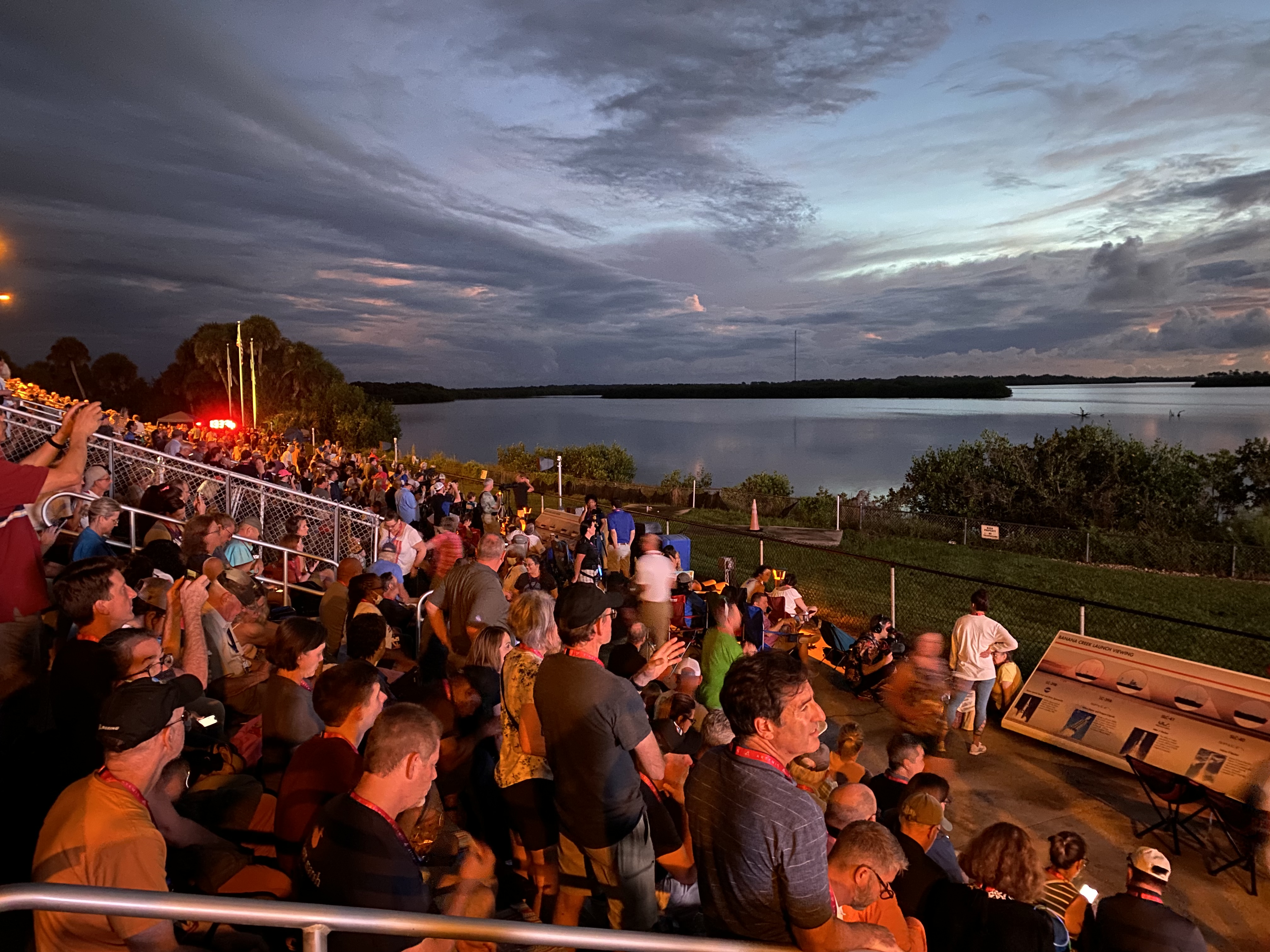
The Crowd Waits for the Launch in the Morning Gloom

There is a public address system at this site along with a large TV screen. We received several announcements while we waited in which we were kept informed as to the progress of the tanking process. 

Artemis 1 at Sunrise

As the sun came up, the clouds over the ocean formed a nice backdrop. The hydrogen flame continued to burn in the background as the liquid oxygen tank vented a white cloud from the upper stage.

The sun rose at about 7 AM and it began to get hot. I wandered the grounds and counted about 50 busses, and if each was full when it arrived, then there were probably close to 2,500 people waiting for the launch.

About 8 AM, the announcer described a problem with the #3 engine on the core stage, and at about 8:45, the mission was scrubbed. We went back to the busses, rode back to the airport, and left for the day.

The Banana Creek viewing area is a great spot. It overlooks a large body of water. Launch Complex 39 is clearly visible, especially from high in the bleachers where it’s possible to see over the bushes at the water’s edge. I used a 500mm lens. At that location, the towers and rocket filled the frame. This lens is big, heavy, and unwieldy, but worth it.

Our instruction sheet said that there would be a limited supply of food and water. This turned out to be false. There are restrooms at the Banana Creek site (with running water) and the visitor center opened at 4:30 AM (with a food vendor inside), and other vendors offered snacks and drinks for sale outside the visitor center.

So, there was no launch. Hopefully we’ll get another chance to see it go.